Boston Real Estate Investors Association

Education designed for local investors

Real Estate Investing Workshops That Lead to Closed Deals

Information alone rarely moves an investor forward. Progress comes from learning practical skills, applying them to real opportunities, receiving useful feedback, and developing relationships with people who understand the Greater Boston market. Those opportunities are available through Boston REIA.

  • Practical education
  • Local connections
  • Ongoing learning
Boston REIA real estate investing workshops
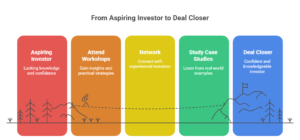
From education to actionLearn the process, analyze opportunities, and build your team.

A workshop should create a usable next step

Why Some Real Estate Investing Workshops Do Not Produce Results

Many investors have attended a seminar, taken pages of notes, and returned home unsure what to do next. The presentation may have been energetic and the information may have sounded impressive, but the investor still lacks a clear process for evaluating a real property in a real Massachusetts municipality.

That gap is not always caused by a lack of motivation. A national presentation cannot fully explain Boston-area acquisition costs, older housing, municipal permitting, tenant considerations, construction pricing, local financing, or block-by-block market differences. Investors need education they can connect to the properties and decisions directly in front of them.

A productive workshop should help an investor answer practical questions. What kind of property am I looking for? How will it create a return? Which numbers must I verify? What could go wrong? Who should inspect the building? How will I finance the purchase and any repairs? What is my exit plan? When should I walk away?

Boston REIA provides educational events and a local investor community where these questions can be explored over time. A single workshop can introduce a process. Continuing education, local relationships, and repeated deal analysis help turn that process into judgment.

The goal is not simply to finish a class.

The goal is to become better prepared to recognize an opportunity, investigate it carefully, structure it responsibly, and decide whether it deserves your time and capital.

Practical topics for Massachusetts investors

Real Estate Investing Workshop Options at Boston REIA

Boston REIA education can help new and experienced investors strengthen the skills required before, during, and after a transaction.

01

Finding Investment Opportunities

Learn how investors develop relationships, evaluate public and private sources, communicate with property owners, work with agents and wholesalers, and create a consistent acquisition process without relying on one lead source.

02

Deal and Property Analysis

Study purchase price, rent, vacancy, operating expenses, repairs, financing, resale value, cash requirements, holding costs, reserves, and exit options. Good analysis makes every assumption visible.

03

Financing and Capital Readiness

Understand how lenders may evaluate the borrower, property, income, renovation, appraisal, reserves, and exit. Meet local financing professionals and learn how to present an organized opportunity.

04

Renovation and Construction

Explore scopes of work, contractor bids, permits, timelines, payment controls, contingency, inspections, utilities, carrying costs, and the hidden conditions often found in older Massachusetts buildings.

05

Rental Property Operations

Learn about income verification, leases, screening, management, maintenance, bookkeeping, insurance, utilities, turnover, security deposits, capital planning, and the responsibilities of Massachusetts rental ownership.

06

Investment Strategies

Compare multifamily rentals, house hacking, fix and flip, buy and hold, BRRRR, wholesaling, condominiums, commercial property, and other approaches without assuming one strategy fits every investor.

07

Local Market Education

Examine how Boston, Cambridge, Somerville, Quincy, Medford, Malden, Newton, Waltham, Revere, and other Massachusetts communities differ in price, housing, transportation, regulations, and demand.

08

Building an Investor Team

Connect with attorneys, lenders, contractors, agents, inspectors, property managers, accountants, insurance professionals, and other investors whose experience can support careful execution.

09

Offers, Negotiation, and Exit Planning

Develop a process for setting a price, writing assumptions, preparing questions, evaluating seller information, planning the preferred exit, and maintaining a backup when conditions change.

Start with the fundamentals

Workshops for New Real Estate Investors

A beginner does not need every advanced strategy at once. The first objective is to build a reliable framework for deciding what to pursue and what to avoid. That begins with investment goals, available capital, financing, time, experience, market focus, and realistic expectations.

New investors can benefit from learning the language of a transaction: comparable sales, after-repair value, net operating income, cash flow, debt service, vacancy, capital expenditures, loan-to-value, debt-service coverage, title, contingencies, and due diligence. The vocabulary matters because it helps investors ask better questions and compare opportunities consistently.

Boston REIA workshops and educational meetings can also help beginners understand the professionals involved in a deal. A real estate attorney, lender, insurance professional, inspector, contractor, property manager, accountant, and experienced agent see different risks. Building those relationships before an urgent transaction gives an investor more time to choose carefully.

The strongest early habit is documenting assumptions. A beginner should be able to explain where each rent, repair cost, comparable sale, financing term, and timeline came from. If an important number cannot be verified, it should be treated as a risk rather than a fact.

Apply the lesson to an actual opportunity

Deal Analysis Turns Workshop Information Into Judgment

Investors often understand a formula in the classroom and struggle when the property does not fit the example. Real buildings have unusual layouts, incomplete records, occupied units, old systems, unclear permits, changing construction bids, and sellers who may not know every answer.

A disciplined review begins with source documents. Depending on the strategy, that may include leases, payment history, utility bills, tax records, insurance information, permits, certificates, inspection reports, plans, contractor bids, comparable sales, lender terms, title information, and condominium documents.

Each assumption should be tested. What happens if the completed value is lower? What if renovation takes three months longer? What if a unit becomes vacant, insurance costs more, or the refinance proceeds are smaller? A transaction that works only under perfect conditions may not provide enough protection.

Boston REIA gives investors opportunities to learn how local professionals and other investors think through these decisions. The value is not having someone make the decision for you. It is learning which questions uncover risk and which evidence supports an informed conclusion.

Know when an opportunity does not fit

Learning to Walk Away Is Part of Closing Deals

Successful investing is not measured by the number of offers accepted. Avoiding a poorly priced, underfunded, unlawful, or physically unsuitable property protects capital for a better opportunity.

Workshop education can help investors establish limits before negotiation becomes emotional. Those limits may include maximum purchase price, minimum cash reserves, renovation complexity, acceptable financing, management distance, required documentation, and the minimum return needed for the risk.

A seller’s urgency does not eliminate due diligence. A competitive market does not make missing permits unimportant. A projected rent does not replace a lease or market evidence. A contractor’s rough estimate does not replace a written scope. Investors improve when they can separate the excitement of finding a property from the discipline of evaluating it.

Boston REIA education is intended to help members become more capable decision-makers. Sometimes that supports a well-prepared offer. Sometimes the correct result is declining the transaction.

The learning continues after the room empties

Ongoing Investor Education Through Boston REIA

One event can introduce a strategy, but investors develop skill through repetition. Markets change, financing changes, regulations change, and each property presents different facts. Continuing education allows members to revisit important subjects as their experience grows.

Boston REIA provides meetings, workshops, investor education, news, professional connections, and opportunities to engage with the local investing community. Members can learn from different speakers, compare approaches, and develop relationships with people working in Massachusetts real estate.

This continuing structure matters because the questions become more specific over time. A beginner may ask how to calculate cash flow. An active investor may need to compare two financing proposals, evaluate a change order, review a property-management issue, or understand how a municipality treats a proposed use.

No association, workshop, coach, or professional can guarantee a closed deal or investment return. What Boston REIA can provide is access to education and community that helps investors become more prepared, ask stronger questions, and make better-informed decisions.

Boston REIA opportunities

Attend Boston REIA events Become a Boston REIA member Explore membership benefits Read Boston REIA investor news Access the Boston REIA member area

Every destination in this section belongs to Boston REIA or its membership and event systems. There are no referrals to another REIA.

Create a repeatable path from education to execution

How to Use a Workshop to Move Toward a Closed Deal

Before the workshop, identify your strategy, target market, available capital, financing questions, and biggest knowledge gap. Bring one real or representative opportunity when appropriate. Specific questions produce more useful learning than a general request to explain real estate investing.

During the event, separate concepts from action items. Record which documents you need, which assumptions require verification, which professionals should be consulted, and which risks might disqualify the deal. Do not treat a speaker’s example as a promise that your property will perform the same way.

After the workshop, organize the notes into a checklist and calendar. Contact the appropriate professionals, collect missing documents, revise the analysis, and decide what must happen before an offer or closing. Continue attending Boston REIA education so one unanswered question does not stop all progress.

Finally, review the outcome. If you purchased the property, compare actual costs and timing with the original analysis. If you walked away, identify what protected you. If the offer was rejected, determine whether your valuation process was sound. Every well-documented result can improve the next decision.

Education, relationships, and local experience

Find Your Next Boston REIA Workshop

Whether you are preparing for a first purchase or improving an established investing business, Boston REIA offers opportunities to learn, connect, and strengthen the process behind your next decision.

Boston REIA workshop FAQ

Real Estate Investing Workshop Questions

Education helps investors prepare, but every transaction requires independent due diligence and appropriate professional advice.

What can I learn through Boston REIA workshops?

Topics may include finding opportunities, deal analysis, financing, renovation planning, rental operations, market research, due diligence, and building an investor team.

Are Boston REIA workshops only for experienced investors?

No. Boston REIA serves people at different experience levels, from beginners learning fundamentals to active investors expanding their knowledge and professional network.

Does attending a workshop guarantee that I will close a deal?

No workshop can guarantee a transaction or investment result. Boston REIA education helps members improve their knowledge, analysis, preparation, and local connections.

What should I bring to a workshop?

Bring your goals, questions, notes, and—when appropriate—information about a real or representative property. Remove confidential information before sharing documents with a group.

How do I continue learning after an event?

Attend future Boston REIA meetings, use member education, follow investor news, build relationships with local professionals, and apply the workshop process to actual opportunities.

Move from information to informed action

Start Learning With Boston REIA

Become a Member