
BOSTON REIA • INVESTOR NEWS & INSIGHTS
Californias New Starter Home Laws Transform Small Home Building
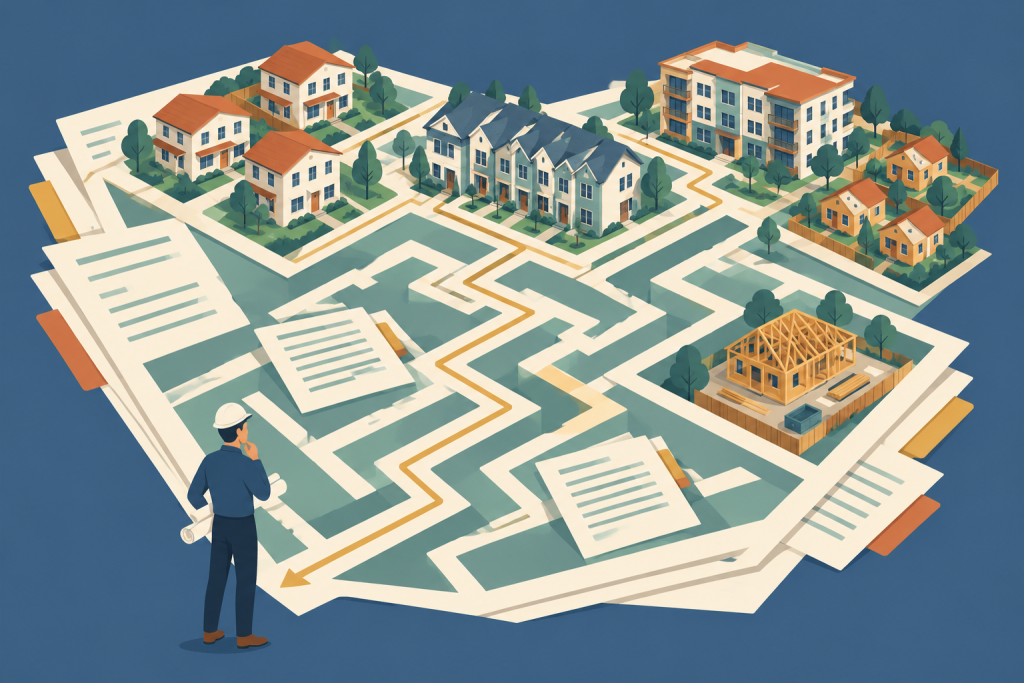
In recent years, California lawmakers have enacted a complex mix of laws aimed at accelerating the construction of more homes, especially smaller and more affordable units.
Small-scale builders and development firms now face a challenging landscape as they navigate a myriad of options to ensure their projects are financially viable. Some are currently in the midst of this process, while others have successfully completed their builds.
These developments suggest that the legislation has largely had positive impacts. However, even seasoned developers express difficulty in keeping pace with the rapid changes.
“We strive to stay informed, but it can definitely be confusing,” said AJ Puthanpurayil, principal and managing partner at Los Angeles-based Dreamwork Development, in a conversation with HousingWire TBD. “Often, the same law might have a different designation after a few months due to revisions.”
Despite the challenges, Dreamwork continues to take on projects, with several small developments underway and others already completed, capitalizing on various legislative changes.
Trenton Klatte, CEO and co-founder of West End Construction, shared with HousingWire TBD that Senate Bill 1123 is “generating the highest degree of density in most projects that we’ve encountered for these types of subdivisions.”
This bill is a follow-up to the Starter Home Revitalization Act, first enacted as Assembly Bill 803 in 2021.
Navigating the Legislative Maze
The original AB 803 allowed properties in multifamily zones to be subdivided into smaller lots for single-family homes without needing ministerial approval.
The first revision in 2023 (SB 684) enabled the construction of up to 10 homes on a property without a public hearing. An existing structure can occupy its own parcel while up to 10 new homes are built on the remaining land. SB 1123, approved in 2024, further broadened this law to encompass vacant single-family lots.
The most recent iteration, SB 1116, which was signed into law by Governor Gavin Newsom last month alongside other housing legislation, expands the range of eligible locations and curtails local regulations. This law will take effect on January 1.
In addition to the Starter Home Act and its iterations, builders have SB 1211, SB 9, and AB 1033 on their radar.
SB 1211 allows for the construction of up to eight detached accessory dwelling units on lots with existing apartment buildings, limited to the number of current units. Meanwhile, AB 1033, passed in 2023, enables cities to permit the sale of backyard units as condominiums.
This year, Newsom also enacted AB 1751, known as the Missing Middle Townhome Ownership Act, which mandates local governments to approve subdivision maps for qualifying townhome projects.
SB 9 permits the division of a single-family lot into two, allowing for up to two homes on each. However, its effectiveness has not met initial expectations.
Roi Omer, owner of Valley Boutique Builders, remarked to HousingWire TBD that for such subdivisions to succeed, land ownership and available funding are crucial. While SB 9 can lead to savings on zoning and pre-construction costs, “Most individuals who split their properties still bear the burden of building two new homes,” he noted. “That’s not inexpensive.”
Interestingly, the challenge may not lie in the legislative framework. Omer pointed out that lenders are still adapting to these laws, and the current high-interest environment poses additional challenges for these projects.
The Boom in Backyard Units
The current shift toward small-home legislation has its origins in the popularity of backyard units.
This trend began in 2016 with the introduction of SB 1069 and its counterpart, AB 2299. Signed into law by then-Governor Jerry Brown, both took effect in 2017, mandating cities to permit accessory dwelling units (ADUs) on most residential lots, while reducing parking requirements and limiting local review processes. Any local regulations conflicting with state law became “null and void.”
Detached units were permitted to expand up to 1,200 square feet—comparable in size to a small home—thus legalizing more than just garage conversions and granny flats.
This led to a significant rise in permitting: statewide ADU permits surged from just over 1,000 in 2016 to more than 35,000 in 2023, accounting for about 22% of new housing permits, as reported by the Bay Area Council. Although builders have expressed concern over the lack of up-to-date permitting statistics, anecdotal evidence suggests that demand remains robust.
Lawmakers have continued to refine this framework. A 2019 legislative package (SB 13, AB 68, and AB 881) established a 60-day approval timeframe, capped side and rear setbacks at four feet, and prohibited impact fees for units under 750 square feet. It also restricted cities from imposing maximum size limits below 850 square feet, or 1,000 square feet for units with two or more bedrooms.
The ADU legislation has laid the groundwork for subsequent small-home initiatives, establishing statewide standards, curtailing local oversight, and enforcing tight approval timelines.
The Subtle Distinction Between ADUs and Small Homes
An ADU in one context could qualify as a small home in another, depending on the applicable legislation. This flexibility allows builders that specialize in ADUs to apply the same designs toward cottage court developments.
“The construction processes are quite similar,” Klatte noted. “However, the entitlement and permitting strategies can differ for developers to navigate.”
Innovative approaches are emerging among builders. California-based BuildCasa has completed a townhome infill project under the revised SB 684 and has recently started marketing units, including a 797-square-foot two-bedroom, two-bathroom home priced at $675,000. Paul Steidl, co-founder of the firm, announced on LinkedIn that the existing home on the site was sold earlier this year.
In Hawthorne, near Los Angeles International Airport, Puthanpurayil’s company is developing six townhomes under SB 684. Additionally, they are replacing an abandoned structure with seven townhomes and four ADUs at another site. They have also acquired a closed school from a church, planning to replace it with ten three-story townhomes and ten ADUs on the ground floor.
“We analyze the maximum density we can achieve on a lot, ensuring it aligns with our financial interests,” Puthanpurayil explained, noting they purchased the property for about $1 million.
Klatte expressed that ADUs have become highly sought after by investors and homeowners looking to expand living space, and he anticipates a similar trend emerging for starter homes.
“I expect this will become increasingly common throughout Southern California in the future,” he added.