
BOSTON REIA • INVESTOR NEWS & INSIGHTS
How Zoning Reform Is Turning Parking Lots Into Housing
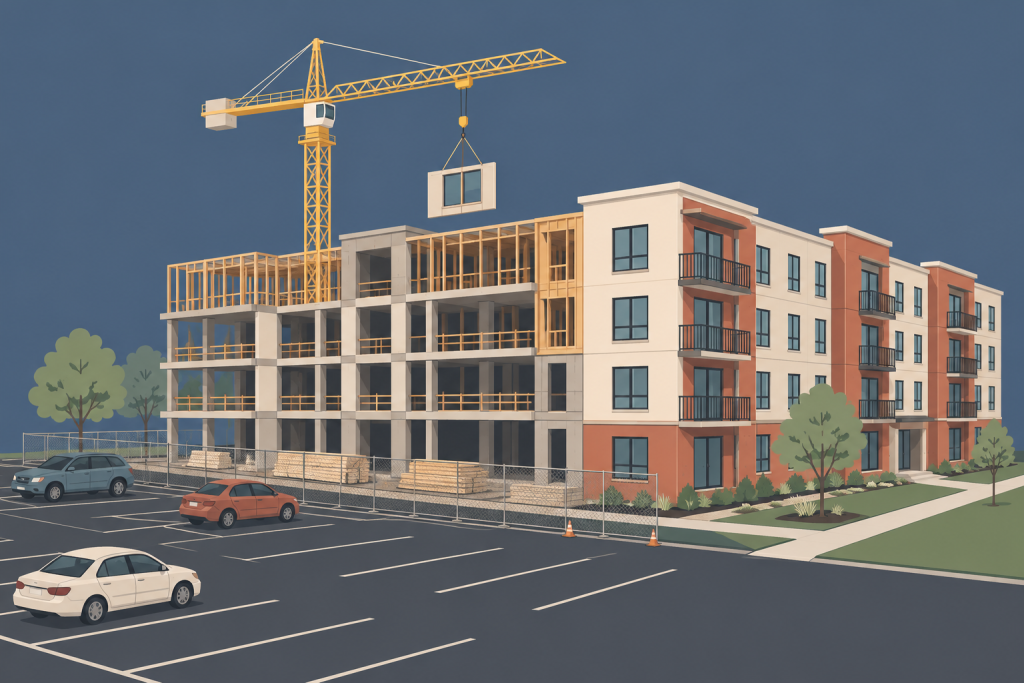
For decades, developers paved land for parking. Now, housing reforms are making it easier to turn some of those lots into homes.
California has created faster approval paths for housing on commercial sites, Florida has opened commercial and industrial land to qualifying affordable housing, and National City, a San Diego suburb, has raised height limits to make redevelopment more practical. But California also shows how cities and neighborhood groups can resist projects despite those reforms.
The opportunity is substantial. In U.S. cities with more than 500,000 residents, a median of 26% of downtown land is used exclusively for parking, according to the U.S. Department of Transportation.
Opening parking lots to housing
California’s Assembly Bill 2011 created a path to ministerial approval—a review against objective standards without a public hearing or environmental review—for qualifying apartments on sites primarily used for offices, retail or parking. AB 2243 expanded the rules for commercially zoned property when it took effect in 2025.
Florida’s Live Local Act similarly requires cities and counties to allow qualifying multifamily rentals on commercial, industrial and mixed-use land without rezoning or a public hearing. At least 40% of the units must remain affordable for 30 years. Lawmakers have amended the 2023 law three times, most recently in 2026.
National City took a local approach, increasing the height limit in its mixed-use zones from three stories to four in 2025. The change helped make Market View, a 120-unit workforce housing development, feasible on a parking lot beside Manolo Farmers Market.
Resistance to reform
Faster approvals have not ended neighborhood opposition. In San Francisco, neighbors are suing over an 848-unit project at 15 Marina Blvd. that would replace a Safeway parking lot with housing above a new store. They argue that the city wrongly found the project eligible for AB 2011 and denied them a hearing. To bring the case to federal court, opponents invoked an 1871 law commonly known as the Ku Klux Klan Act. The developer has asked the court to dismiss the suit.
In Los Angeles, planners rejected a proposal for 398 homes at Woodland Hills Country Club in August, citing concerns about mountain lions. The state Department of Housing and Community Development said the city violated AB 2011. Pro-housing groups have sued the city, and the developer has threatened a separate claim for damages that could exceed $20 million.
Under AB 2011, residents do not get a hearing to comment on a qualifying project or its environmental effects, said Sheri Bonstelle, a Greenberg Glusker land-use attorney who represents developers.
“Neighbors are really upset that they no longer have a voice at all,” she said.
The faster route also comes at a cost. AB 2011 requires labor standards, including prevailing wages, that Bonstelle said can raise construction costs by roughly 30%. Developers weigh that expense against the time and uncertainty of discretionary review and a possible lawsuit under the California Environmental Quality Act.
“It’s literally a monetary analysis,” she said. Some of her clients have decided that the added cost is worth the certainty of an approval path with less entitlement risk. Lenders favor that certainty too, she said, especially in a tight lending market.
How smoothly the process works varies by city. Los Angeles requires a detailed AB 2011 application, giving neighbors documents they can request and review. Smaller cities that have not handled such projects can be less prepared, Bonstelle said. Some ask developers for building-permit materials too early in the process; others decline to process applications because they believe the state law does not apply to them. Her firm is seeking a state technical-assistance letter in one particularly difficult case.
Projects taking shape
In Florida, the Live Local Act applies to parking lots zoned for eligible commercial, industrial or mixed uses, said Patrick Chopson, an architect and co-founder of Cove. That is a significant source of potential housing sites, he said.
One planned project is Skyway Flats in St. Petersburg. Elmington Capital Group proposes 174 affordable apartments on surface parking beside an assisted living facility. The five-story building would include 28 one-bedroom, 100 two-bedroom and 46 three-bedroom apartments. All would serve households earning 30% to 80% of area median income; 18 would be reserved for young adults aging out of foster care.
Pinellas County commissioners unanimously approved $6 million in March to buy the land and will require the apartments to remain affordable for 99 years. The $77 million project also relies on federal tax-credit equity, tax-exempt bonds and a state loan through the Live Local Act. Elmington expects to close financing and begin construction in early 2027.
In National City, the investment group behind Market View has broken ground. The city’s decision to allow four-story buildings was important to the project: The previous three-story cap limited how many homes could fit on the site, Andrew Regenberg of Gafcon told the planning commission.
“We believe that more housing means more opportunity not just for our market, but for local businesses,” said Chris Dallo, who heads the investment group.
Market View will comprise three buildings with mostly studios, one-bedroom and two-bedroom homes, connected by open space and the market. Designed by RDC and built by R.D. Olson Construction, it is scheduled for completion in the first quarter of 2028.
The groundbreaking followed “a long, thoughtful process and extensive due diligence,” said Councilmember Ditas Yamane, who represents the district.