BOSTON REIA • INVESTOR NEWS & INSIGHTS
Why Brand Loyalty Outweighs Volume for Toll Brothers Homebuilder Profits
Five Years of Growth, Two Distinct Outcomes
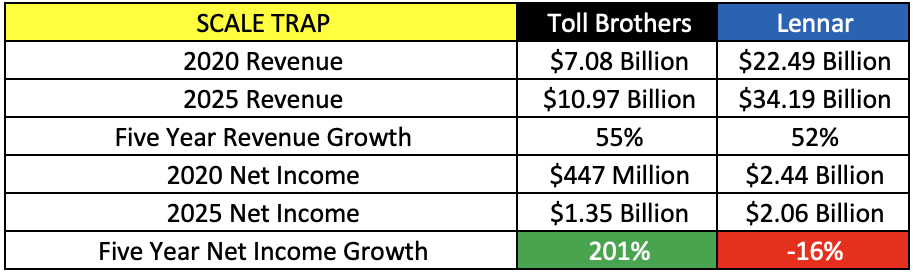
In a span of five years, two of the largest homebuilders in America saw their revenues surge by approximately 50%. However, one company managed to triple its profits, while the other ended up with lower earnings than it had five years ago. Remarkably, both operated in the same industry, faced the same interest rates, and navigated through a similar national housing cycle.
The results were vastly different.
The key difference wasn’t in the number of houses sold, but rather in the demographics of their buyers, the type of homes they built, and how much those buyers were willing to pay. This distinction highlights the variance between simply growing a homebuilding company and cultivating a valuable homebuilding business. This is the reason Toll Brothers stands out in contrast to the industry’s fixation on volume, suggesting that brand identity may be one of the most overlooked advantages in housing.
Among the major homebuilders in this analysis, only one grew orders in the last quarter, and it wasn’t the largest; it was the priciest. Toll Brothers achieved a 5% year-over-year increase in signed contracts, while Lennar saw a 9% decline in orders, and KB Home experienced a 12% drop.
Initially, one might think this reflects a trend toward luxury housing. A deeper look reveals it as a strategic story, particularly focusing on the often-ignored aspect of brand.
Over five years, both Toll Brothers and Lennar enjoyed similar revenue growth rates, yet their profit trajectories diverged significantly. That divergence is crucial; revenue and unit volume alone do not provide the complete picture. The quality of the earnings is essential, and the last five years illustrate this point effectively.
Reviewing the fiscal results from 2020 to 2025:

The revenue data tells a familiar tale: both builders increased their revenues by roughly 50%. However, the profit figures tell an entirely different story. Toll Brothers more than tripled its net income, while Lennar, despite generating nearly $12 billion more in annual revenue than in 2020, ended up earning less.
It’s worth noting that Lennar wasn’t stagnant; its orders rose by 9% in fiscal 2025, totaling close to 84,000 homes. By the industry’s preferred metric, volume, it was indeed winning. While scale brought in more revenue, it didn’t improve profitability. Ultimately, the buyer is more crucial than the sheer number of units sold.
Toll Brothers serves a different segment of the market, with an average home price of around $960,000 in fiscal 2025, contrasted with Lennar’s average of about $391,000.
Different Economic Realities for Buyers
Approximately 70% of Toll Brothers’ customers in fiscal 2025 were move-up or move-down buyers, generally possessing equity in existing homes. About 26% of those purchasers made cash payments.
According to Toll’s CEO, Douglas Yearley, the company’s mortgage rate buydown participation was “very low” because its buyers “do not require a lower rate to qualify for a mortgage.” This shifts the dynamics of demand. A first-time buyer dealing with financing for a $391,000 home is more constrained by monthly payments. In contrast, an affluent buyer with cash and equity focuses on choosing a home, not just qualifying for one.
Factors such as product quality, location, household wealth, financing needs, and available options all influence pricing power. Builders who genuinely understand their customer base can make informed decisions regarding price, incentives, product offerings, and sales pace, unlike those competing solely on sensitivity to payment.
The goal is not to sell the most houses; it’s about selling the right homes to the right buyers at sustainable margins. Margin is where strategic planning becomes quantifiable.
In fiscal 2025, Toll reported gross margins of 25.6% on home sales, or 27.3% when utilizing its adjusted metrics, while Lennar reported 17.7%. This nearly 10-point difference per home sold is telling.
While gross margin doesn’t equate to net income and a single comparison doesn’t establish one strategy as superior across all markets, the disparity underscored that mere volume isn’t a sufficient measure of performance. Each home has its economic implications influenced by incentives, construction expenses, land acquisition costs, and the capital tied up until closing.
When demand decreases, builders may adjust their pace by offering incentives. As of the end of fiscal 2025, Lennar was operating with around 14% in incentives and price adjustments, and about 12% in the recent quarter. In contrast, Toll’s average incentives were about 8% during fiscal 2025. While incentives can make sense in certain markets, that choice to sacrifice margin for volume must be reevaluated when it becomes a habitual strategy.
There’s no advantage in protecting sales volume if the underlying economics are deteriorating.
Brand as the Strategic Shield
What spreadsheets often overlook is this: during my tenure at KB Home, I recognized that this industry encompasses three fundamental elements: brand, land, and strategic moat. Most builders focus primarily on land acquisition, fewer give brand serious consideration, and almost none regard it as the protective barrier that sustains margin during market fluctuations. Toll Brothers does.
Since its founding in 1967, Toll Brothers has branded itself as the premier luxury homebuilder in the nation. In 2026, Fortune recognized Toll as the No. 1 home builder on its World’s Most Admired Companies list—marking the ninth time it has achieved this distinction. This esteemed reputation, built over decades, is reflected in its financial success.
Consider what Toll’s buyers invest beyond the initial price. In Q4 of fiscal 2025, buyers typically spent an average of around $206,000 per home on design upgrades, structural modifications, and premium lot selections—amounting to about 24% above the base sale price.
This represents a significant insight. Rather than relying on incentives to draw in buyers, Toll’s clientele invests extra to customize the homes they choose. One approach relies on incentives to create demand; the other fosters demand through a respected brand. That is the essence of a strategic moat in real estate.
While a brand doesn’t eliminate market cycles—Toll’s adjusted gross margin fell from 27.5% to 25.6% last quarter, resulting in a profit decline—it alters how a builder endures economic downturns. It provides flexibility to maintain prices, encourages buyer personalization instead of discounts, and fosters competition based on the intrinsic value of the home, rather than solely its price. In a landscape where competitors vie for the same payment-sensitive customers, the builder with a strong brand engages in a different, more meaningful dialogue.
While scale can be replicated and land can be acquired by anyone with sufficient funding, cultivating a brand that resonates with buyers and commands respect takes decades, making it incredibly difficult to displace. Scale should serve as a competitive advantage, not merely an objective. Large builders do have notable advantages: purchasing power, access to capital, established vendor relationships, refined processes, and the ability to distribute overhead across more developments. Yet, these virtues only hold significance when they enhance the economic outcomes of specific markets.
Real estate is not a one-size-fits-all national commodity. Variations in employment, affordability, land prices, infrastructure, buyer preferences, and available inventory fluctuate greatly by market, and often even by submarket. A strategy effective in one location might fail in another, and a product appealing to one segment can completely miss the mark with another. Moreover, acquiring land at an unfavorable price can undermine efficiencies achieved elsewhere.
The solution is not to abandon scale; rather, it’s to align scale with local market conditions, consumer needs, and brand identity. This necessitates discipline in decisions regarding where to build, what to construct, whom to target, how much land to acquire, and how much capital to invest.
Insights for the Industry
The performance of Toll Brothers does not definitively prove that luxury homes will always outperform affordable options, nor does one quarter confirm a long-term victor. The entry-level buyer market remains critical to American housing. However, Toll’s success challenges a long-held belief in homebuilding: that simply achieving greater volume, expanding into more markets, and increasing scale will inherently strengthen a business.
This five-year comparison prompts a better inquiry: what occurs when two companies experience nearly identical revenue growth rates, but one translates that growth into substantially higher profits? The answer lies beneath the surface of the headline figures: the characteristics of the buyer, the product offerings, pricing strategies, land acquisition costs, organizational structure, the capital required for each sale, and the brand identity that determines whether customers come to them or need to be enticed.
Scale is merely a tool. Margin reflects the outcome. Brand serves as the defensive shield. And understanding the buyer is where it all begins.
The top homebuilder isn’t necessarily the one who closes the most transactions. It’s the one that crafts a sustainable, profitable business by truly understanding its customers, its marketplace, and the significance of its brand to its clientele.